

Quick answer: Yes. Eligible digital marketing, including paid social run by a pre-approved vendor, can be supported up to 50% for Singapore SMEs through the EDGE grant. The grant is also the single most effective thing we have ever put in an ad. When we advertised it, our cost per lead fell by more than half.
We are PaperCutCollective, a Singapore digital marketing agency and a pre-approved vendor for the EDGE grant. From May to October 2026 we ran Meta ads for ourselves and tested one change at a time. The clearest finding had nothing to do with design. It was that talking about the grant, in plain words, beat every other message we tried. This post explains what EDGE is, what it can and cannot cover, and why the grant message worked so well.
What the EDGE grant is and what changed from PSG
For years, Singapore SMEs funded a lot of their digital work through PSG. From 30 September 2026, that support for digital marketing moved to the EDGE grant from Enterprise Singapore. The headline for a business owner is simple: eligible digital marketing can be supported up to 50% when it is delivered through a pre-approved vendor.
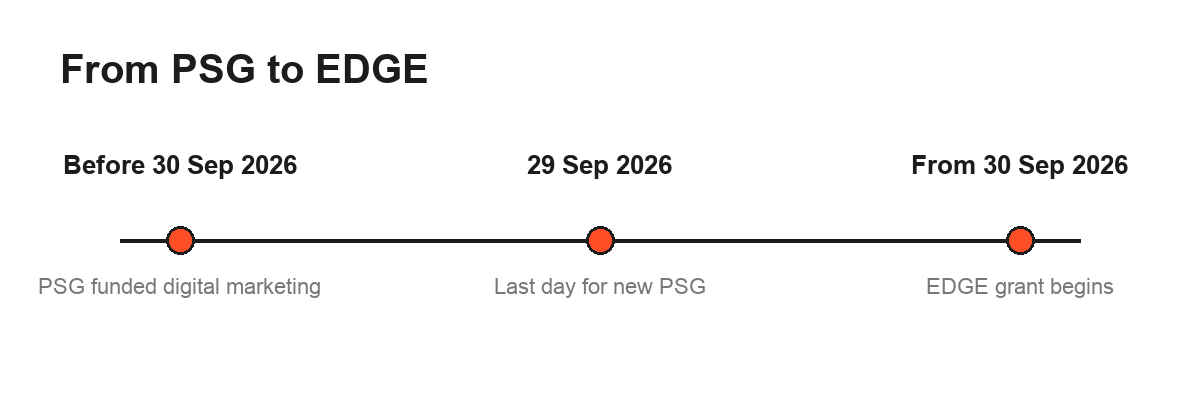
The eligibility basics are that your company is registered in Singapore and has at least 30% local shareholding. We are keeping the detail light here on purpose, because grant terms change and the only source worth trusting is the official one. For current rates, eligibility and the list of supported activities, read the Enterprise Singapore EDGE page. If a blog, including this one, states a figure that the official page does not, believe the official page.
The practical change for most owners is small. The name is different and the application sits in a slightly different place, but the idea is the same as before: the government shares the cost of growing your business, and a pre-approved vendor helps you access it.
It helps to remember why schemes like this exist. Singapore wants smaller companies to invest in real capability, not just survive month to month, so it shares the cost of the work that builds that capability. Marketing counts, because a business that cannot be found or cannot explain itself does not grow, however good its product is. For an owner weighing up whether to spend on ads, SEO or a new website, support that covers up to half the cost changes the maths. It turns a nice-to-have into a decision you can actually justify this quarter.
What EDGE can and cannot cover in a marketing plan
People ask us what the grant pays for, and the honest answer has two parts: what is commonly supported, and what you must check.
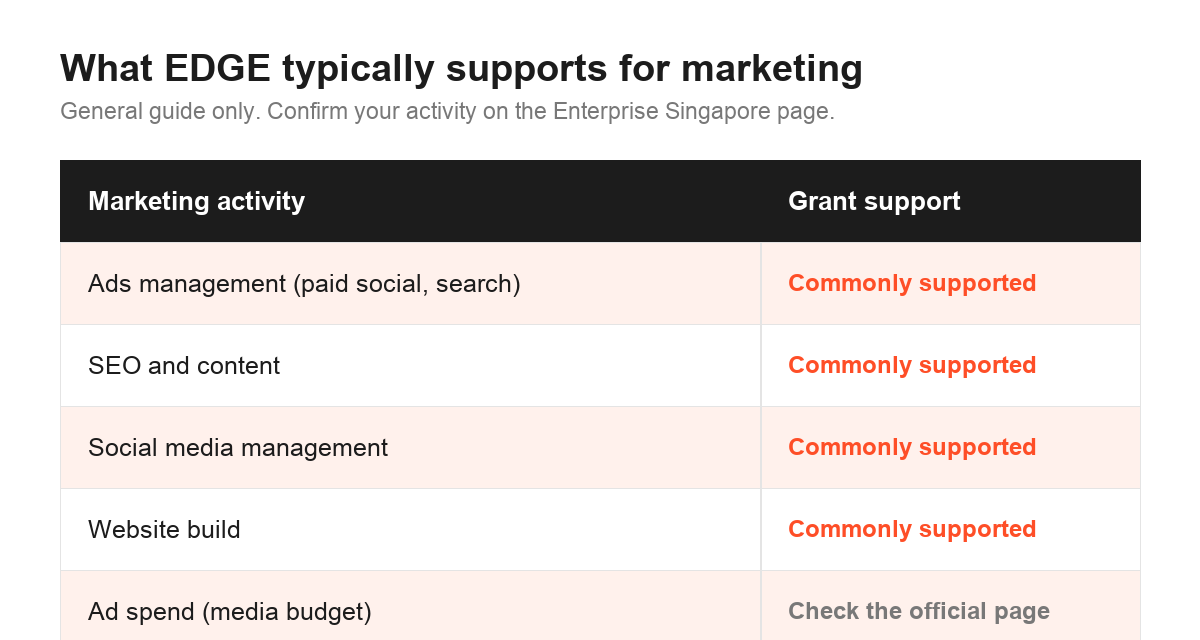
Commonly part of an EDGE-supported marketing plan through a pre-approved vendor:
- Management of paid social, such as Facebook and Instagram ads.
- Search engine optimisation and content.
- Social media management.
- Website build and related work.
The one that needs care is ad spend itself, the money that goes to Meta as media budget. That is a different thing from the fee to manage the ads, and whether it qualifies is a question for the official page, not for us. We say that plainly because we would rather under-promise than have you plan a budget on a wrong assumption. Treat the management of your marketing as the part a pre-approved vendor supports, and treat the media budget as a line to confirm with the official source.
The useful way to think about it is as a plan, not a single invoice. Most SMEs do not need only ads, or only SEO, or only a website. They need a few of these working together, and a grant-supported plan can bundle the management of that work under one scope. That is also better marketing. Ads bring people in, the website turns them into enquiries, and SEO keeps bringing people in long after the ads stop. When you scope the plan first and then check each part against the official criteria, you get a programme that holds together, rather than a random list of tactics that each need their own justification.
Why “the government funds half your marketing” outperformed every other message
Here is the result that shaped the whole project. When we changed the core message of the ad from a pain-point line to “the government funds up to 50% of your marketing”, the cost per lead fell from about $48 to about $19. Same audience, same format, same budget. Only the message changed.
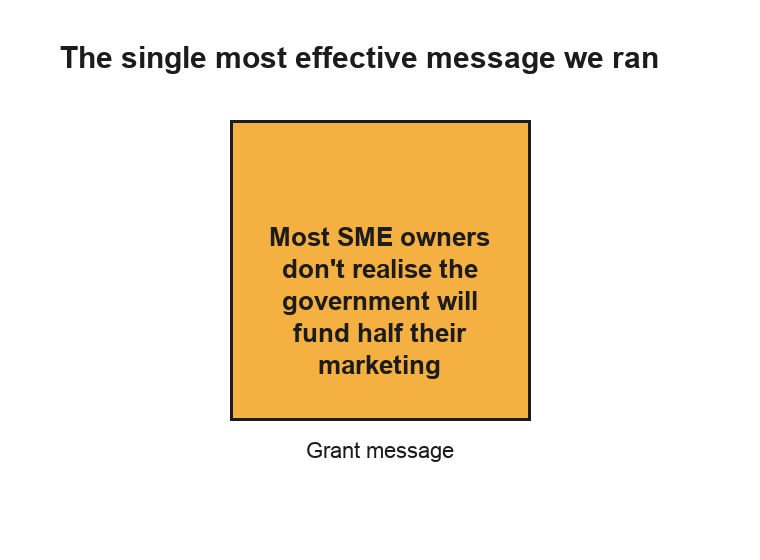
Then we reworded it. The strongest version said, in effect, “most SME owners don’t realise the government will fund half their marketing.” That phrasing framed the grant as something you might be missing out on, not just a discount on offer. It outperformed a plain savings line and a pain-point line alike.
It helps to see the three families of message we tried. The first was pain: your marketing is not working, your competitors are ahead. The second was savings: get up to 50% off your marketing. The third was loss: you probably qualify for funding you are not claiming. All three point at the same grant, but they land very differently in a feed.
Why did loss framing beat the others? Our read is that an owner who already knows marketing is expensive does not need reminding of the pain. And “save up to 50%” sounds like every sale they scroll past, so it slides off. But “you probably qualify for money you are not claiming” is specific, it is about them, and it carries a small sting of missing out. People will click to remove a nagging doubt faster than they will click to grab a discount. The reword in round three leaned into exactly that doubt, and it was the cheapest grant message we ran.
We kept the numbers in this story to those two, $48 and $19, because that is the clean like-for-like test. We did not keep chasing decimal points on the message after that, because the big move had already happened and the next gains came from the ask and from cutting weak ads, not from more clever wording. The full creative breakdown, including the exact words that won and the dozens that lost, is in our creative lessons post.
What happened when PSG became EDGE overnight
There is a cautionary tale in this project for anyone running grant ads. On a single day, we renamed the grant from PSG to EDGE across every ad, and at the same time we launched a new lead form and switched on phone verification. Three changes, one day. The result was that the learning reset on every ad at once, and for a while we could not tell what was working.
The lesson is the same one that runs through everything we do: change one thing at a time. It applies to the words in your ad, and it applies just as much to the plumbing behind them. If we had renamed the grant on Monday, changed the form the following week and touched verification the week after, we would have known which change did what. Because we did all three together, we learnt nothing for several days and had to rebuild from a clean control. It cost us time and budget for no insight, which is the worst kind of spend. If you are updating grant branding across live ads, treat it as its own change, make it on a quiet week, and leave everything else alone while the system settles.
One small, useful detail came out of the rename. Our best-performing grant card said “the government” rather than “EDGE”, because most owners had not yet heard the new name. A grant only persuades people who recognise it, so until a new scheme is well known, describe the benefit in plain words and let the official name sit in the background.
How SME owners respond to grant messaging
Running the grant as an offer taught us how owners actually react to it, which is not always how you would expect.
They respond to a reason to act. Headlines that invited them to “see if you qualify” beat headlines that simply restated the offer, such as “get up to 50% funded.” The first feels like a small, doable step. The second feels like an advertisement.
They ignore urgency and proof when it is thin. A card shouting urgency and a card boasting about client numbers both lost. Owners have seen a thousand countdowns and a thousand “trusted by” badges, and a grant does not need either. The grant is the proof. Let it speak.
They tap what they can read quickly. Plain cards with a clear sentence beat designed layouts and busy graphics. When the subject is money the government will share, clarity is more persuasive than polish. You can see exactly how cheap those plain cards made our leads in the cost post, where the stable arms settled at about $14 a lead.
What does that mean for your own grant ads? Keep the sentence short and specific, lead with the owner and their money rather than with the scheme name, and give one small next step like checking if they qualify. Resist the urge to add a countdown, a stack of logos or a clever graphic. Every one of those we tried made the ad worse, not better. If you are tempted to design something beautiful, design the sentence instead. The grant is already the most interesting thing in the ad, so your job is to get out of its way and make it easy to act on.
How to apply through a pre-approved vendor
You do not have to work out the grant alone. The usual path, in general terms, looks like this.
- Talk to a pre-approved vendor about what you want to do, so the plan matches a supported activity.
- Get a written quote. A good quote shows the scope, the fee and which parts sit inside the grant, so there are no surprises later.
- Submit the application through the official channel, with the vendor helping you line up the documents.
- Once it is approved, the work begins, and the support is handled according to the official terms.
A word on the quote, because it is where most confusion lives. A clear quote separates the fee to do the work from any media budget, states which activity it falls under, and sets out what you receive each month. If a quote blurs those lines, ask for a clearer one. You are about to put it in front of a grant process, and vague scope is what causes delays. On timelines, we will not give you a number, because they shift and only the official process is authoritative. A good vendor sets expectations honestly and keeps your application moving rather than promising a date it cannot control.
We are deliberately not quoting approval times or promising outcomes, because those are set by the official process, not by us. What a pre-approved vendor adds is simple: we make sure the plan fits a supported activity, the quote is clear, and the paperwork is right the first time. You can see how we structure that on our EDGE grant page.
What cheap leads do not solve
One honest note to close on. The grant message gave us cheaper leads, but a cheaper lead is not a customer. The work that turns a lead into a client happens after the click: how fast you follow up and whether you get the person onto a call. A grant can open the conversation. It cannot have the conversation for you. We would rather you win on follow-up with $40 leads than lose on follow-up with $14 ones.
Frequently asked questions
What is the EDGE grant?
The EDGE grant from Enterprise Singapore supports eligible digital marketing for Singapore SMEs, up to 50% when delivered through a pre-approved vendor. It replaced PSG for digital marketing from 30 September 2026. Check the official Enterprise Singapore page for the current terms.
Is PSG still available?
For digital marketing, new applications moved to EDGE from 30 September 2026. If you had a PSG project approved before then, follow the official guidance for it. For anything new, EDGE is the route to take.
Does EDGE cover Facebook ad spend or only the agency fee?
Management of paid social by a pre-approved vendor can sit inside an EDGE-supported plan. Whether the media spend itself qualifies is a question for the official Enterprise Singapore page, so confirm there before you plan a budget.
How long does EDGE approval take?
Timelines change, so we do not quote a number here. Check the official Enterprise Singapore page for current processing times, and a pre-approved vendor can walk you through the steps so nothing stalls.
Can a new company apply?
The basics are a Singapore-registered company with at least 30% local shareholding. A newer company can ask a pre-approved vendor to check its situation against the official criteria before applying.
Want to know what you could claim? Get a free EDGE quote and we will scope your marketing, show you which parts may be supported, and point you to the official criteria for the rest.