

Quick answer: You do not need a big budget to test Facebook ads. You need a control, one change at a time, about $20 a day per arm, and the patience to read three numbers in order. That is the whole method we used to run 26 variations and take our cost per lead from about $54 to $14.
We are PaperCutCollective, a Singapore digital marketing agency. From May to October 2026 we ran Meta lead ads for ourselves across 11 rounds and 26 variations. The other posts in this series cover what a lead cost, which creative won, and the hidden plumbing faults that nearly fooled us. This post is the method underneath all of it: the simple, repeatable way we tested, which you can copy on a small budget starting this week.
Why bother with a method at all, rather than just making good ads? Because without one, you cannot tell a good ad from a lucky week. Most small advertisers run a single ad, watch the cost wander, and form strong opinions from numbers that are really just noise. They scale on a good fortnight and panic on a bad one, and after months of spending they still cannot say what works. A method fixes that. It is not clever and it is not expensive. It is a handful of rules that turn spending into learning, so that at the end of each round you know one more true thing than you did at the start. Everything below is those rules, in the order we apply them.
Rule one: always run a control
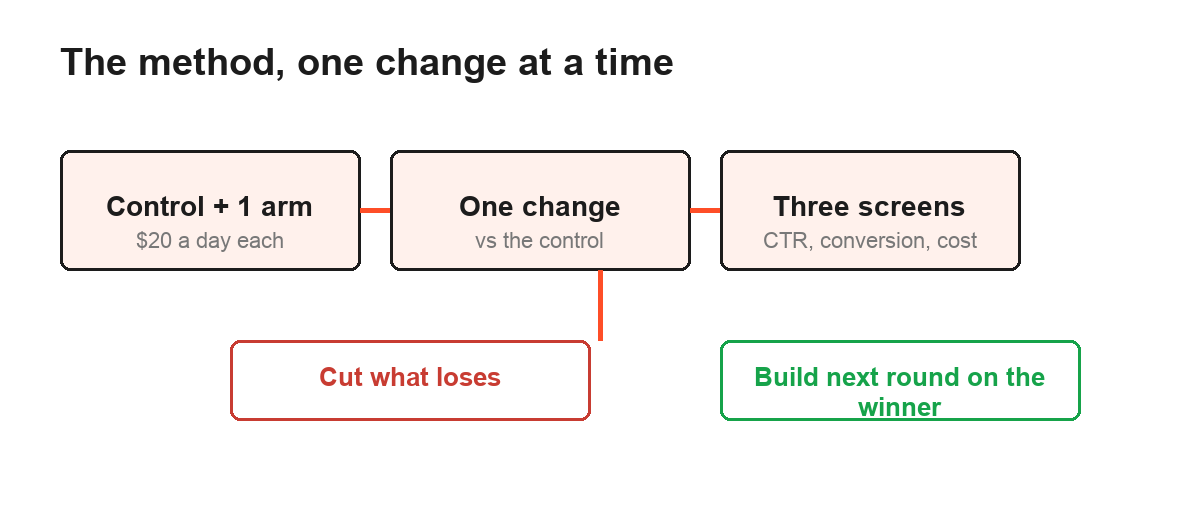
The single most important habit is to keep one ad running as your control and never touch it. Everything you test is measured against it. Without a control you are guessing, because Facebook’s costs move day to day for reasons that have nothing to do with you, and a cheap lead on Tuesday might just be a cheap Tuesday. With a control running beside your test, both ads feel the same Tuesday, so any difference between them is real. When a test beats the control convincingly over complete days, it becomes the new control, and you test the next thing against that. This is how you climb, one proven step at a time, instead of lurching around.
Rule two: change one thing at a time
Every test arm should differ from the control in exactly one way. One message, or one word, or one ask, or one colour, or one format. Not two. The moment you change two things, you lose the ability to say which one moved the number, and the test is wasted even if the result looks good. We learnt this the hard way when we changed three things on one day and reset the learning across our whole account, which we tell in full in the plumbing post. It cost us two weeks and taught us nothing. One change at a time feels slow, and it is the fastest way to actually know something.
Rule three: about $20 a day per arm
You do not need a large budget. We gave each test arm about $20 a day, and that was enough to read link click-through within a few days and cost per lead within two to three weeks. A bigger budget does not buy a better answer. It buys the same answer sooner. And it will never make a weak offer into a strong one, it will just find out that it is weak faster and more expensively. If you have more to spend, we would rather you run more arms at $20 a day than one arm at $80, because breadth teaches you more than depth early on. The exception is that you should not split so thin that no arm gathers enough clicks to trust. On a small budget, that usually means a control and one or two variations, no more.
The three numbers we read, in order
Reading an ad well means looking at the right number at the right time. We read three, in this order, and never jumped ahead.
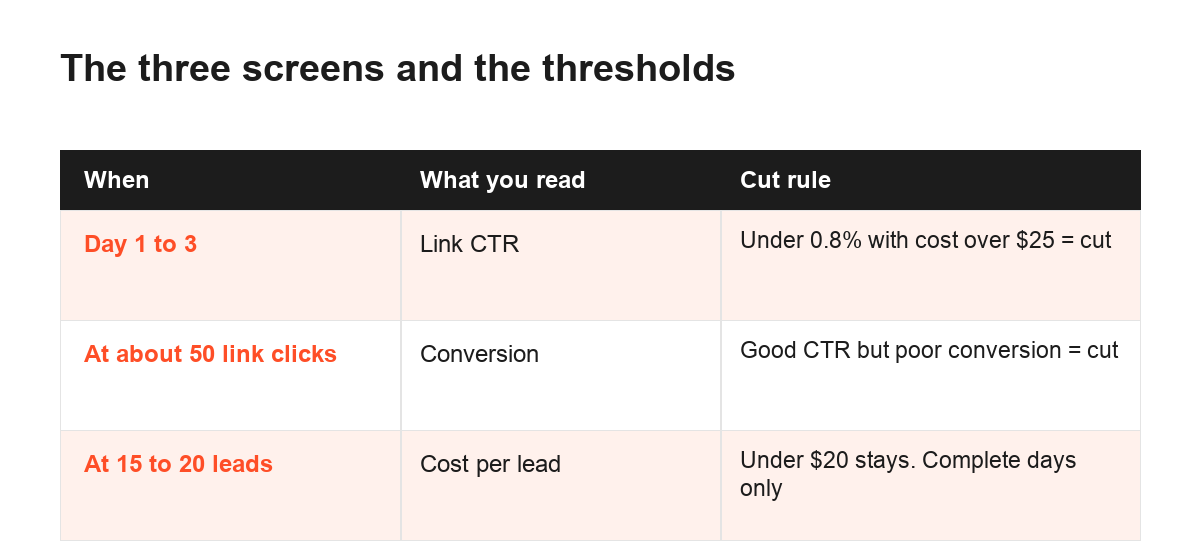
First, link click-through rate, in the first one to three days. This tells you whether the ad earns the click. It moves early, so you can read it fast. We watched link clicks only, never total clicks, because a tap on see more counts as a click and will flatter a weak ad. A low link click-through here means the ad is not pulling, and no amount of waiting will fix a creative that nobody clicks.
Second, conversion rate, once an arm has about 50 link clicks. This tells you whether the people who clicked go on to become leads. You cannot read it early, because a handful of clicks is noise. Once an arm has gathered around 50 link clicks, the share that completes the form becomes meaningful. A high click-through with a low conversion means the ad is pulling the wrong people, or something in the form is turning them away.
Third, cost per lead, at 15 to 20 leads. This is the number that actually matters, and it is the slowest to firm up. Until an arm has 15 to 20 leads, its cost per lead bounces around too much to trust. Once it settles, this is the figure you compare against the control to decide whether the change won. Judging an ad on cost per lead before it has enough leads is the most common way people fool themselves.
One discipline binds all three: only ever compare complete days. A morning behaves differently from an evening, and a part-day comparison will mislead you every time. Let whole days play out before you read anything.
The order we tested in
What you test first matters as much as how you test. We worked from the biggest lever to the smallest, because there is no point polishing a detail on an ad whose offer is wrong.
- The offer first. What the ad is really about moved our cost per lead further than everything else combined. We found our biggest drop here, from about $48 to $19, just by changing the message.
- The exact wording second. Inside a winning offer, the precise sentence still matters, and rewording ours took the cost down again.
- The ask third. What you request changes how many people say yes. More on this below, because it is the clearest small win we found.
- Format and colour fourth. Plain beat fancy, and colour barely moved the needle. The full creative breakdown is in the creative post.
- Placement and audience last. We kept the audience broad and placements automatic, and let the system find the cheap spots rather than guessing them ourselves.
If you test in this order, each stage sets up the next, and you never waste budget perfecting a small thing on top of a big mistake. The common error is to run it backwards, agonising over colours and fonts while the offer stays weak. We did some of that early, and every hour of it was wasted, because a sharper shade of orange cannot rescue a message nobody cares about. Start at the top of the list, bank the big win, and let it carry you down to the small ones.
A worked example: the ask test
Here is the method in miniature, with a real result. We had a steady control asking people to book a free 30-minute strategy session. We built one variation that changed exactly one thing, the ask, to a free quote. Same audience, same image, same budget, same caption. Only the call to action moved.
The variation lifted the share of link clicks that became leads from 11% to 17%, at the same cost per click. Because we had changed only the ask, we could say with confidence that the ask did it, and the new, smaller request became our control for the next test. That is the whole loop in one example: a control, one change, complete days, enough clicks, a clear result, and a new control to build on. No guessing, no stacking changes, no drama.
When to cut and when to wait
Patience and decisiveness have to live together. You need patience to let complete days play out, because an ad can have a slow morning and a strong night, and cutting on half a day throws away ads that would have worked. You need decisiveness to kill a clear loser early, because a weak ad does not heal, it just spends. Our working rule was to cut an ad running under about 0.8% link click-through with a cost over $25 in its first few days, before it drained budget we could use elsewhere. The cheapest thing we did all project was kill losers early. The second cheapest was not panicking and killing a winner during a normal wobble. Knowing which is which comes from the three numbers above, read in order and on complete days.
A useful way to think about it: an early cut and an early scale are the two decisions most likely to cost you. Cut too late and a loser eats the budget a test needed. Scale too early and a big same-day budget jump can reset the ad’s learning and push the cost you just found back up. So we cut losers quickly but raised winners slowly, in steps, over complete days, rather than pouring budget in the moment an arm looked good. Fast to kill, slow to scale. That one line would have saved us a fair amount of the money we spent learning it.
Log everything, or you will forget
By round eleven we could not have told you what we tried in round three from memory. The log saved us.
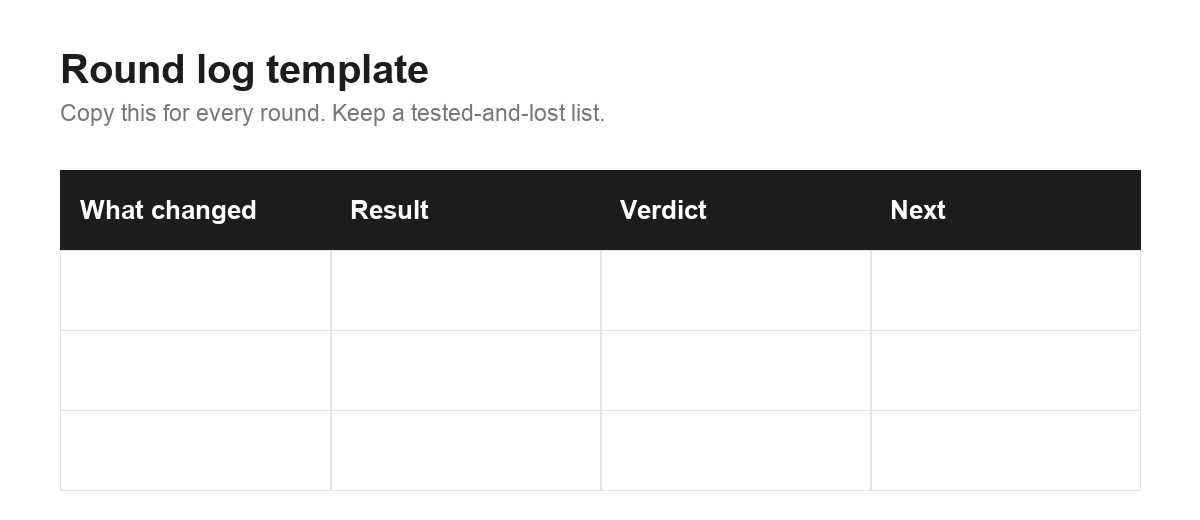
Keep a simple record of every arm: what it was, what single thing you changed, the dates it ran, and the three numbers when they settled. It does not need to be fancy. A spreadsheet is plenty. The value is that it stops you repeating a test you have already run, it shows you the path from your first expensive ad to your cheapest one, and it turns a pile of hunches into a story you can actually learn from. When someone asks why your winning ad looks the way it does, the log is the answer, round by round. Testing without logging is just spending with extra steps.
One honest note to close on
This method is good at one thing: finding the cheapest way to get someone to raise their hand. It cannot make that person a customer. The work that turns a lead into a client happens after the form, in how fast you follow up and whether you get them onto a call. A cheaper lead that sits in an inbox overnight is worth less than a dearer one you call in ten minutes. So use the method to drive your cost down and your certainty up, then spend the time you saved on following up faster. The test finds the lead. You win the customer.
If you would like this run for you, it is exactly how we manage Meta ads for Singapore businesses, and much of it can sit inside an EDGE-supported plan. For the current grant terms, read the official Enterprise Singapore EDGE page.
Frequently asked questions
How much budget do I need to test Facebook ads?
Less than most people think. We ran each test arm on about $20 a day, which is enough to read link click-through in a few days and cost per lead within two to three weeks. A bigger budget finds the answer faster, but it does not make a weak offer work. Start small and change one thing at a time.
How long before I judge a Facebook ad?
Give it complete days, never half days, because mornings and evenings behave differently. We read link click-through in the first one to three days, conversion once an arm reached about 50 link clicks, and cost per lead at 15 to 20 leads. Act on sustained drift, not one quiet afternoon.
What should I test first in a Facebook ad?
The offer, by a long way. In our test the message moved cost per lead further than the audience, the design or the colour combined. Get the offer right, then the exact wording, then the ask, and only then worry about format and placement. Testing design first is testing the smallest lever first.
How many Facebook ads should I test at once?
Few enough that each still gets enough budget to read. On a small budget that usually means a control and one or two variations, each on about $20 a day. A dozen tiny arms teach you nothing because none of them gathers enough clicks to trust.
How do I know if a change actually worked?
Keep a control running the whole time and change exactly one thing against it. If the variation beats the control over complete days with enough clicks to be real, the change worked. If you change several things at once, you cannot know which one did anything, which is the most common way tests are wasted.
Want us to test your ads properly? Get a free EDGE quote and we will scope your paid social, set up the control and the first tests, and tell you what support you may qualify for.