

Quick answer: A tested Facebook lead ad to Singapore SME owners lands at about $13 to $20 a lead. An untested one costs $50 or more. In our own spending the offer moved the price far more than the budget, the audience or the design.
We are PaperCutCollective, a Singapore digital marketing agency and a pre-approved vendor for the EDGE grant. From May to October 2026 we did something most agencies never show you: we ran Meta ads for ourselves, spent about $22,500 SGD, and tested one change at a time to find the cheapest lead for a free marketing quote.
It was 11 rounds and 26 variations. We judged every ad on link clicks, not on all clicks, and we cut weak ads early. This post is the cost story: what a lead cost at each stage, what cost moved the needle, and how to budget your own first month. Every number here comes from that one account.
Why advertise to ourselves at all? Two reasons. First, we wanted numbers we could publish, with no client to protect and nothing to dress up. Second, a free quote for SME owners is a hard, competitive offer to sell, so if a method works here, it tends to work for the clients we run ads for. The downside is honest too: these are our numbers for our offer, and a different product will read differently.
How we ran the test
The setup was deliberately boring, because boring is what makes a result trustworthy. We targeted Singapore, ages 25 to 54, broad, with Advantage+ audience expansion off for most arms so we could read the audience cleanly. Each test arm got about $20 a day. We ran a control and changed exactly one thing against it, whether that was the message, a single word, the ask, the colour or the format.
We judged on link clicks, not on every tap, because Facebook counts “see more” on a long caption as a click. We read link click-through rate in the first one to three days, conversion once an arm reached about 50 link clicks, and cost per lead at 15 to 20 leads. We only ever compared complete days, and we acted on sustained drift, not one bad afternoon. If you want that framework step by step, it is in our testing guide.
What a Facebook lead costs in Singapore
Here is the whole journey in one view. We started with a generic “grow your business” video and finished with a plain text card, and the cost per lead fell by roughly 75% along the way.
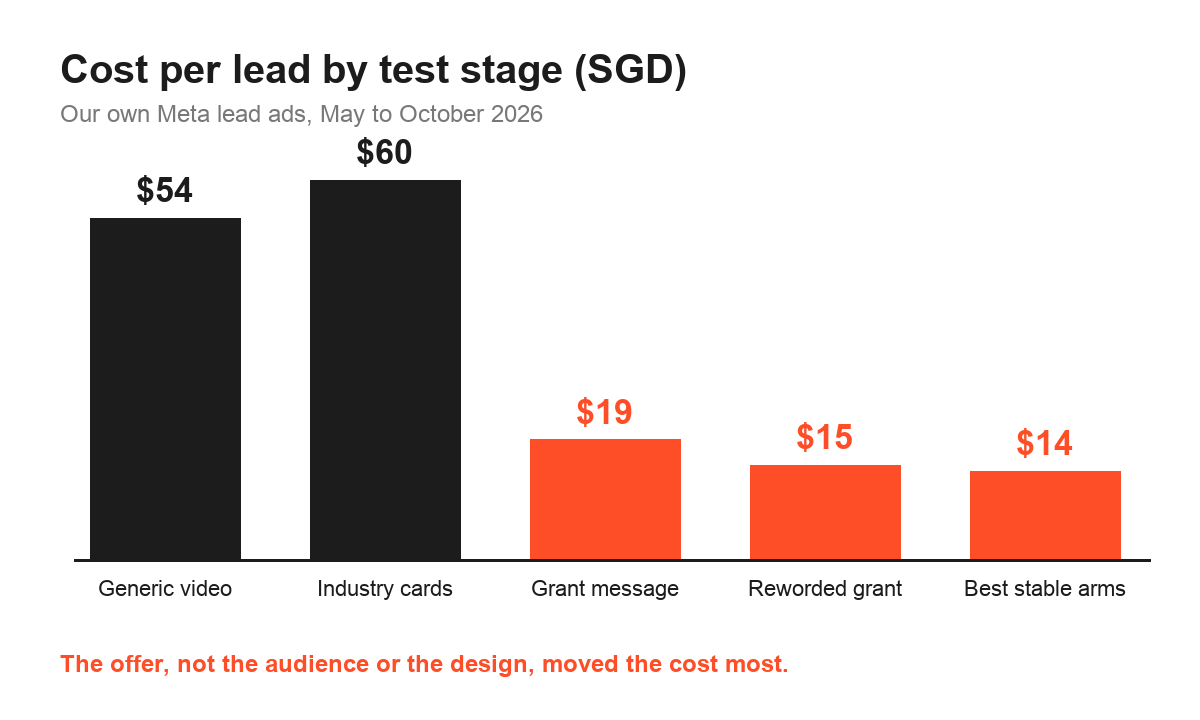
The stages, in order:
- Start, generic video: about $54 a lead. A friendly “grow your business” message, nicely shot, and expensive.
- Industry-specific cards: about $60 a lead across five industries and both broad and niche audiences. The audience and the industry barely mattered.
- The grant message: $19 a lead, against $48 for the old pain-point message. This was the turning point, and we tell that story in full in our creative lessons post.
- Reworded grant message: about $15 a lead once we found the exact phrasing.
- Best stable arms: $13 to $14 a lead, held across complete days.
So the honest range is wide. The same agency, the same product and the same month produced $54 leads and $14 leads. The difference was almost entirely what the ad said.
What moves the cost most, in order
If you only remember one thing, remember the order below. We learnt it the slow way, by changing one variable at a time and watching complete days.
1. The offer. Moving from “grow your business” to “the government funds up to 50% of your marketing” took the cost from about $48 to $19 on a like-for-like test. Nothing else we did came close. The offer is the single biggest lever on a lead ad.
2. The exact words. Even inside the winning offer, the phrasing mattered. Rewording the grant message to “most SME owners don’t realise the government will fund half their marketing” brought the cost to about $15. Same idea, better sentence, cheaper lead.
3. The ask. Changing what we asked for, from a “free 30-minute strategy session” to a “free quote”, lifted the share of clicks that became leads from 11% to 17% at the same cost per click. A smaller, clearer ask converts better.
4. Plain over fancy. A plain amber square with black text beat designed layouts, a video and a carousel. Like-for-like, moving colour around changed the cost by only a few dollars. The words did the work, not the art direction.
5. Broad over niche. Narrow industry targeting did not beat a broad Singapore audience of 25 to 54. We kept broad targeting and let the system sort it out.
6. Cutting fast. The cheapest thing we did was kill losers early. An ad under about 0.8% link click-through with cost over $25 got cut in the first few days, before it drained the budget. We explain the exact method in our testing guide.
Notice what is near the bottom of that list: design, colour and audience. Most people start there. We would start with the offer every time.
Cost by placement and audience
From 25 August to 20 September we read cost per lead by placement. The gap between the cheapest and the most expensive spot was large.
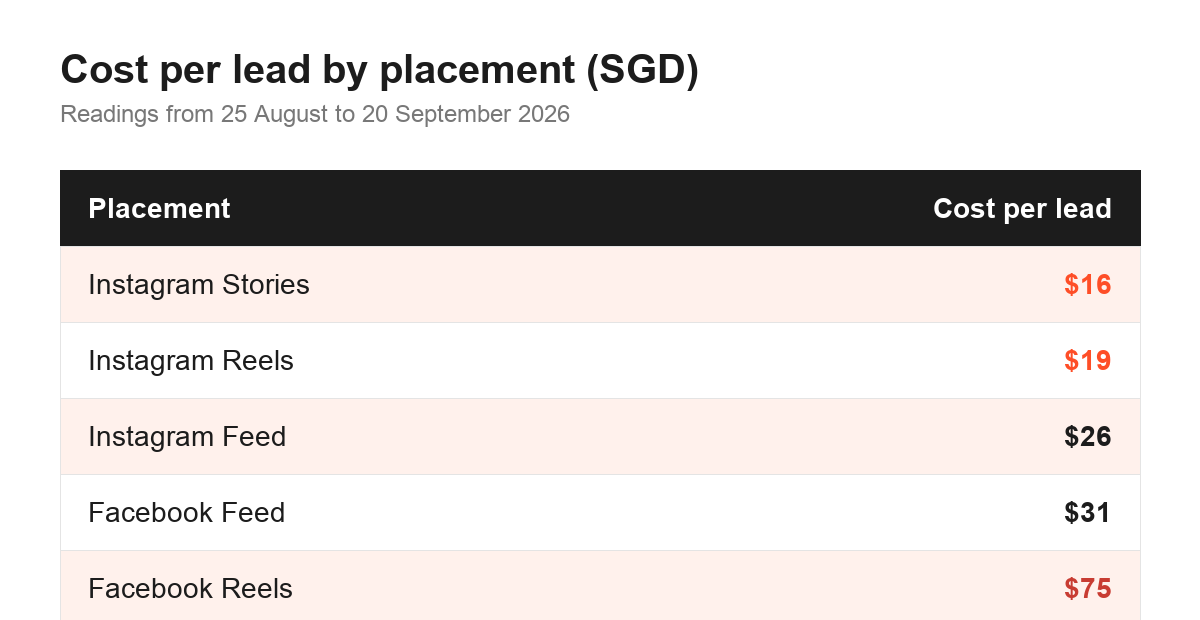
Instagram did the heavy lifting. Instagram Feed alone took nearly half of all spend, and Stories and Reels on Instagram were the cheapest places to get a lead. Facebook Reels was the most expensive at $75. We did not switch everything to Instagram Stories, though. We kept automatic placements, because the system spreads budget to where leads are cheapest on the day, and that beat us hand-picking spots.
On audience, women aged 35 to 54 were the cheapest group at $17 to $19 a lead, and men 35 to 54 sat around $34. The catch is that this flipped from arm to arm, so we did not lock targeting to one group. For a $20 a day budget, the lesson is simple: do not slice your audience thin. Keep it broad, keep automatic placements on, and let a small budget find the cheap pockets on its own.
One nuance worth knowing: when we ran a version of the winning card to Reels and Stories only, it got the highest link click-through rate of anything we tested, about 1.8%. More taps, though, did not mean more leads. That version converted fewer of its clicks, so the cheaper cost per click did not carry through to a cheaper lead. It is a good reminder that a placement can win on attention and still lose on outcome, which is exactly why we judge on cost per lead and not on click-through rate alone.
What a click costs and how many clicks become leads
A cost per lead is really two numbers hiding together: what you pay for a click, and how many clicks turn into leads. Both matter, and watching only one will fool you.
Across arms, link clicks cost between $1.12 and $3.50. Our winning card bought them at about $1.12, which is cheap. But a cheap click is wasted if nobody fills in the form. Form completion ran at 10 to 17 leads per 100 link clicks, depending on the ask. The “free quote” ask sat near the top of that range, the “strategy session” ask near the bottom.
So two ads can have the same cost per click and very different cost per lead, purely because of what happens after the click. When you read your own numbers, always put cost per link click and conversion rate side by side. One without the other hides the truth. There is a related trap here, counting the wrong clicks entirely, which we cover in the plumbing post.
How to budget your first month
Here is a worked example using our numbers. Treat it as a shape, not a promise, because your market and offer will differ from ours.
At $20 a day: that is about $600 in a month. At a $14 lead, which is our stable figure, that is roughly 40 leads. At the start, before you have found your offer, expect nearer $50 a lead, so plan for 10 to 12 leads in the first weeks while you test. The budget is not buying leads yet. It is buying answers.
At $50 a day: that is about $1,500 a month, or roughly 100 leads at a $14 cost once you are stable. More budget does not make a weak offer cheaper. It just finds out faster. We would rather run $20 a day with a sharp offer than $50 a day with a soft one.
Whatever you spend, split it. Run a control and one or two test arms, give each about $20 a day, and change one thing per arm. A single big-budget ad teaches you almost nothing, because you cannot tell which part worked.
One more word on pacing. When an arm starts winning, the instinct is to pour budget in on day two. We would wait. Big same-day budget jumps can reset the system’s learning and push your cost back up for a while, so you lose the very thing you just found. Let a winner prove itself over complete days first, then raise budget in steps rather than all at once. In the first month your job is not to scale. It is to find the offer, the words and the ask that make a cheap lead possible, and to cut everything that does not. Scaling is a month-two problem, and it is a much nicer problem to have once the cost per lead is already low and steady.
What cheap leads do not solve
Cheaper leads are not more customers. A $14 lead and a $54 lead can turn into the same number of clients, or the cheaper one can turn into fewer, if the people are a worse fit. The real work starts after the lead: how fast you follow up and whether you get the person onto a call. We drove our cost down a long way, and we still treat the lead as the start line, not the finish. Chase speed of follow-up before you chase another dollar off the lead.
The EDGE grant and Meta ads
If you run a Singapore SME, there is a reason the grant message worked so well in our ads: it is real money. The EDGE grant, which replaced PSG for digital marketing from 30 September 2026, can support up to 50% of eligible digital marketing costs for Singapore SMEs through a pre-approved vendor. The basics are that your company is registered in Singapore with at least 30% local shareholding. For the current terms, read the official Enterprise Singapore EDGE page.
PaperCutCollective is a pre-approved vendor, so the management of your paid social can sit inside an EDGE-supported plan. Whether the media spend itself qualifies is a question for the official page, and we would rather you check it there than take our word. You can see how we would structure it on our EDGE grant page, and read more about how we run Meta ads for Singapore businesses. If you want the full story of advertising the grant itself, our creative post breaks down the message that won.
Frequently asked questions
How much does a Facebook ad lead cost in Singapore?
In our own test it ran from about $54 for an untested ad to $13 to $20 for a tested one. The biggest swing came from the offer, not the budget. Your own number depends on your market, your offer and how fast you cut weak ads.
What is a good cost per lead for B2B in Singapore?
There is no single good number, because a lead is only worth what it converts to. For a free marketing quote to Singapore SME owners, our stable ads landed at $13 to $14 a lead. A different offer or industry can sit higher or lower and still be healthy.
Are Instagram or Facebook leads cheaper?
In our account Instagram was cheaper. Instagram Stories came in at $16 and Reels at $19 a lead, while Facebook Feed was $31 and Facebook Reels $75. We still kept automatic placements and let the system find the cheap spots.
How much should I spend to test Facebook ads?
About $20 a day per test arm is enough to read link click-through rate in a few days and cost per lead within two to three weeks. You do not need a big budget. You need one change at a time and the patience to let complete days play out.
Can the EDGE grant cover Facebook ads?
Eligible digital marketing, including paid social managed by a pre-approved vendor, can be supported up to 50% for Singapore SMEs. Whether media spend itself qualifies is a question for the official Enterprise Singapore page, so check there before you plan a budget.
Want a real figure for your business? Get a free EDGE quote and we will scope your paid social and tell you what support you may qualify for. No jargon, no pressure.